Today, we’ll talk about what to expect through the end of the year and how to factor macroeconomic forecasts into investment decisions.
What Is Happening with the Economy?
We have left our economic growth forecast unchanged at 0.8% for the year.
Given the current conditions, this essentially means stagnation. Economic activity is being supported primarily by government spending on the war and consumer spending, much of which is linked to military expenditure. Meanwhile, the civilian economy is largely focused on staying afloat.
What About the USD/UAH Exchange Rate?
I know the USD exchange rate forecast is what interests you most.
By the end of the year, we expect the exchange rate to reach UAH 45.8 per US dollar. Compared with our forecast from February this year, this is a downward revision of 80 kopecks.
Back in our February macro forecast, we wrote that the NBU was already prepared for a controlled weakening of the hryvnia. It seems that this is exactly what we are seeing now, with the process unfolding somewhat faster than expected, partly due to the war in Iran.
Before that, we effectively had 15 months of a stable exchange rate. Since July 2024, the hryvnia had remained within a range of UAH 41–42 per US dollar. Only this year did the NBU allow the exchange rate to cross UAH 43 and then, quite quickly, UAH 44.
Such a prolonged period within the same exchange-rate range accumulated imbalances and created risks that eventually materialized. These included higher oil prices and stronger demand for the dollar.
A stable hryvnia also encourages the consumption of imported goods: when the exchange rate remains unchanged for a long time, imported products effectively become cheaper for Ukrainian consumers.
A simple example is a three-day Monobank promotion during which around USD 30 million worth of iPhones were sold. And it is easy to see why: the USD exchange rate today is roughly the same as it was when the iPhone 16 was launched, while supermarket prices have increased by 14% over the same period.
So, the iPhone has barely changed in price, while almost everything else has become more expensive. As a result, demand for the dollar increases.
So, if you want to support Ukraine’s foreign exchange market — buy fewer iPhones.
These accumulated imbalances led the NBU to spend USD 18.1 billion to support the hryvnia during the first five months of this year. Over the same period last year, the figure was USD 14.3 billion, roughly a quarter less.
For the full year, we forecast that the NBU will spend USD 41–42 billion to support the exchange rate. In effect, these are resources Ukraine receives through financial assistance from international partners. According to our estimates, this amounts to around USD 51 billion in 2026.
So, a weakening of the hryvnia was already becoming an increasingly necessary step. But what matters is that the NBU has the resources to make this process controlled. And, even more importantly, it is prepared to do so.
Is the NBU on the Side of Investors?
Let’s look at several quotes from the NBU’s latest meeting, where decisions regarding monetary policy were discussed.
The NBU noted that increased foreign-exchange sales were necessary to limit excessive exchange-rate volatility. This, in particular, helped reduce elevated demand in the FX market, stopped the decline in yields on hryvnia-denominated assets, and supported demand for them.
The NBU also emphasized the importance of closely monitoring economic agents’ interest in hryvnia-denominated assets, as their attractiveness has a significant impact on conditions in the foreign exchange market.
Put simply, the NBU is currently on the side of investors in hryvnia assets.
Its objective is to ensure that yields on hryvnia-denominated instruments are high enough to offset depreciation and reduce the public’s incentive to keep buying dollars.
What Does This Mean for OVDPs?
Looking at the results of 2025, this policy appears to have worked.
Over the past year, Ukrainians purchased half as much foreign currency for conversion into cash as they did in 2024. And this did not happen because people simply ran out of hryvnias. On the contrary, investment in hryvnia-denominated OVDPs increased significantly during this period.
Let’s do the math.
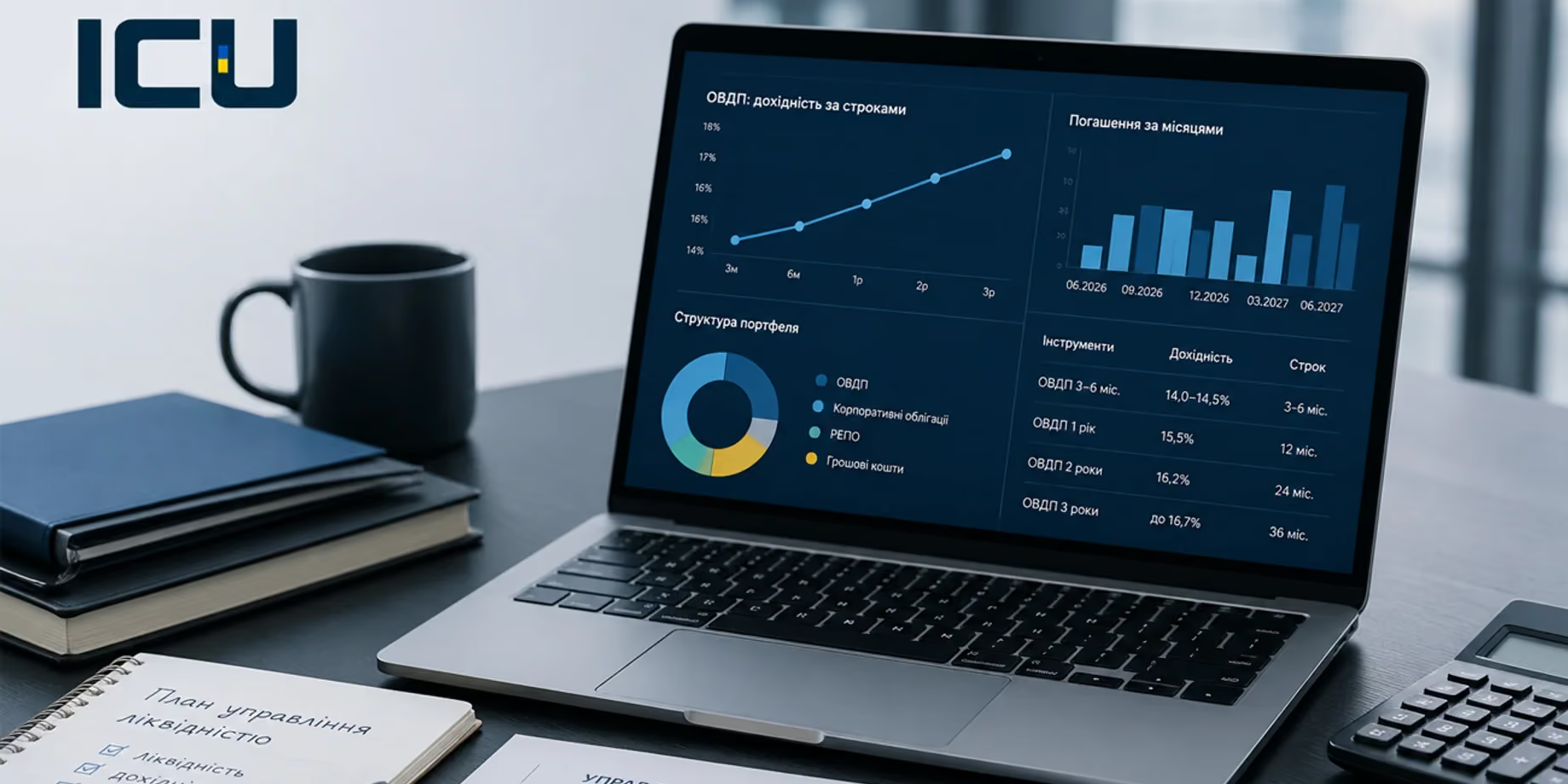
If you bought one-year OVDPs through the ICU Trade platform a year ago, you could have locked in a yield of around 16% per annum in hryvnia.
Over the same period, the USD exchange rate increased by around 8% — from UAH 41.5 to UAH 45 per US dollar.
In other words, the hryvnia yield was approximately twice the rate of depreciation. As a result, when converted into USD, the investment also generated a positive return.
So, the decision to invest in hryvnia-denominated OVDPs a year ago turned out to be the right one.
And what if we had invested at the beginning of this year? At that point, it was possible to lock in almost 17% per annum in hryvnia.
Where Can You Check Historical Yields?
ICU has a Telegram bot called ICU Trade Support for this purpose.
You can select “ICU Quotes” to receive a list of all OVDPs, along with the buying and selling yields for each series.
The message is saved in your history. So even a year later, you can return to it and see what the yield was on the exact day you requested the quotes.
What Should We Expect in 2026?
According to our forecast, the USD exchange rate will rise by around 8% over 2026.
At the same time, we expect hryvnia yields to once again be roughly twice the rate of depreciation.
And even if our forecast turns out to be too optimistic, there is still an additional margin of safety — approximately another 8% of depreciation.
What if we decide to invest today?
It’s simple. Open ICU Trade, go to the “Trading” tab, and look for OVDPs maturing in approximately one year.
For example, an OVDP maturing on June 9, 2027 currently offers a yield of approximately 15.5% per annum.
For this investment to remain profitable in USD terms, the exchange rate would need to stay below approximately UAH 51 per US dollar.
This means that even despite raising our year-end USD exchange rate forecast to UAH 45.8, hryvnia-denominated investments remain attractive, with a fairly substantial margin of safety.
But this raises the next question: which OVDPs should you choose — six-month, one-year, or two-year bonds?
What Is Happening with Inflation?
This is where the inflation forecast can help us.
For this year, we expect inflation to reach 9.4% year-on-year. This is a significant deterioration compared with the 6.3% we forecast in February.
Some may ask: “What 9%? Have you seen how much prices are actually rising in stores?”
Yes, but it is important to understand that inflation is calculated based on a consumer basket that reflects average price changes across a wide range of categories.
It includes, among other things, utilities, education, and healthcare — and some of these costs may remain fixed for extended periods.
For example, in Kyiv, a metro or trolleybus ride still costs UAH 8 — the same as it did in 2018.
Such prices are also taken into account in the overall inflation index.
Most of the deterioration in this year’s inflation forecast is related to the war in Iran and, consequently, rising fuel prices.
During the first five months of the year, inflation had already reached 5.8%. This is almost the same as in the corresponding period last year, when prices increased by 5.6%.
At the same time, we do not expect the high inflation rates seen in March and April to persist through the end of the year.
More than a third of the consumer basket consists of food, and Ukraine is expected to have a good harvest this year.
Given these forecasts, the NBU has already stated that it does not plan to cut its key policy rate and intends to keep it at a high level for longer than previously expected.
Inflation is one of the key factors guiding the NBU’s monetary policy. And monetary policy, in turn, directly affects the yields offered by hryvnia-denominated assets.
Which OVDPs Should You Choose?
Given the inflation outlook, the additional inflation risks that have emerged, and the NBU’s clear readiness to respond to them, we believe that the chances of OVDP yields declining are currently lower than the likelihood that they will remain at their current levels or even increase slightly.
Therefore, for now, it makes more sense to focus on shorter-term OVDPs — primarily one-year bonds.
Our Fix offer is particularly worth considering.
It allows you to lock in a yield of 15% per annum, while still giving you the option to switch to another OVDP series later if you change your mind, without losing money on the difference between the buying and selling prices.
This is a promotional offer under which the buy and sell prices are equal. This means you retain the flexibility to change your investment decision in the future without losing money on the bid-ask spread.
Conclusion
Of course, no one knows the future. But decisions based on forecasts and plans are significantly better and help avoid most mistakes.
We really cannot know the future. But ICU forecasts it with one of the strongest forecasting capabilities in the Ukrainian market.